 PyleHound
AI hallucinations in legal practice: causes and technical solutions from PyleHound

The use of artificial intelligence in everyday legal work brings enormous efficiency benefits, but also raises a key question: How reliable are the results? A recent example of this is an incident in which AI misquotes were submitted to the Frankfurt Regional Court. But what exactly is behind these errors, why do they happen, and how does PyleHound technically ensure that you can rely on the search results?
What exactly are AI hallucinations?
In the field of artificial intelligence, the term “hallucination” refers to the phenomenon of a model outputting information that sounds convincing but is in fact false or fictitious. In a legal context, this means, for example, that the AI cites a Federal Court of Justice ruling that was never handed down, refers to a contract clause that does not exist in the uploaded document, or invents different deadlines. The tricky thing is that this misinformation is presented in a linguistically flawless manner and is absolutely plausible in context, so that at first glance it appears to be legitimate legal fact.
Why do AI language models hallucinate in the first place?
AI models such as ChatGPT, Anthropics Claude, and Google's Gemini fall into the category of “large language models” (LLMs). These models are not knowledge databases in the traditional sense, where fixed facts can be retrieved. Rather, they are sophisticated, probabilistic systems for text generation. When given an input, the model simply calculates which word is statistically most likely to follow next.
If the model lacks the specific factual context for a given situation, it prioritizes the generation of fluent, linguistically plausible text. In legal practice, this mechanism leads to AI formulating file numbers, paragraphs, or justifications that sound absolutely logical and convincing, but do not exist in reality. AI does not generate deliberate false statements, but merely provides the most probable linguistic continuation.
The key to the solution lies in context: the risk of hallucinations can be drastically reduced if the model does not have to rely on its abstract “world knowledge.” If the AI is provided with the necessary, verified factual knowledge directly within the conversation, the need for statistical guessing drops to zero. The model then relies on the information that is actually available instead of filling gaps with plausible fictions. This is precisely the principle that PyleHound exploits.
How does PyleHound prevent hallucinations?
To prevent this probabilistic guessing, PyleHound relies on an architecture that is fundamentally different from normal AI chat applications. Strict technical guardrails ensure maximum precision and traceability in research.
Context Engineering

Our deep research function analyzes every line of the uploaded documents within a project and identifies semantic matches for your query. These search results are first presented exclusively to you as the user before the language model processes the content. You proactively decide which relevant text passages are loaded into the AI context. This principle of targeted preselection also applies to our legal database connection.
Strict quote validation
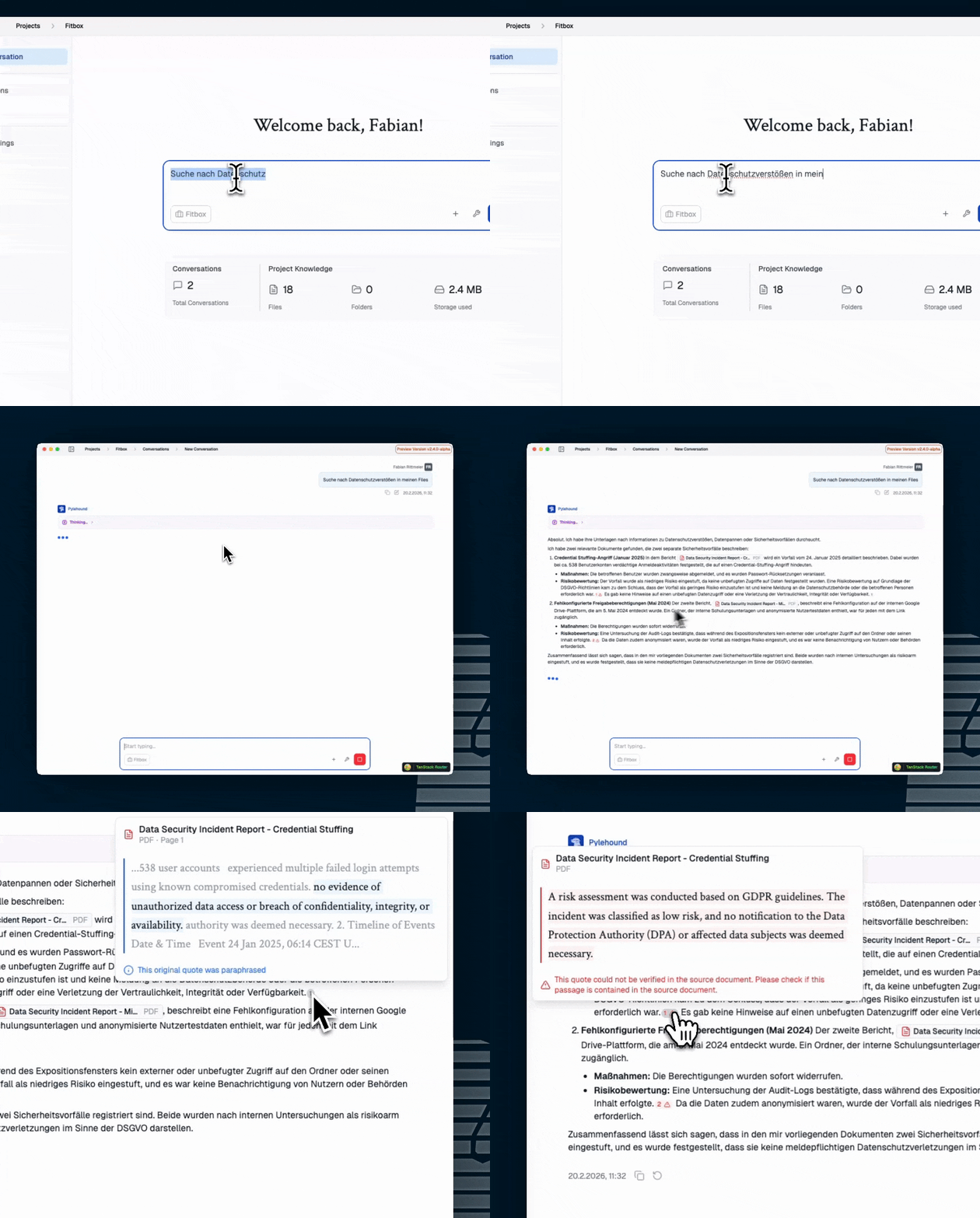
PyleHound instructs the LLM in the background to accurately label used files and citations. The system then validates the file names and original citations against the source documents. Citations that cannot be verified are transparently marked as such.
Isolated project rooms

When responding to search queries, PyleHound only accesses the documents that are currently selected in the project. Unintentional mixing of data is technically impossible. Related files should therefore always be organized within a common project.
What do you as a user still need to check yourself?
PyleHound takes care of time-consuming document analysis, structures large amounts of data, and prepares information in a targeted manner with precise source references. However, the final legal assessment and quality control remain a purely human task.
As a user, you review the source links transparently displayed by PyleHound, check the original context in the document, and classify the information legally. This legal duty of care is essential—especially when it comes to the question of who is ultimately liable for AI errors. PyleHound provides you with verified facts in a matter of seconds, but the strategic and legal guidance is always yours.
